Industrial manufacturing facilities operate large electrical distribution networks where PCC panels (Power Control Center panels) manage high-current power flow from transformers to multiple downstream feeders. In such environments, one of the most severe electrical safety risks is an arc flash event inside electrical panels.
An arc flash occurs when electrical current deviates from its intended path and travels through ionized air between conductors or between a conductor and ground. The resulting arc produces extremely high temperatures, intense light, and explosive pressure waves that can severely damage equipment and pose serious danger to personnel.
For this reason, arc flash hazard analysis in industrial PCC panels has become an essential part of modern industrial electrical safety engineering. Proper analysis helps identify potential arc flash risks and enables engineers to implement effective arc flash protection in PCC panels.
When Electrical Energy Escapes Control: The Physics of Arc Flash
An arc flash event is essentially an uncontrolled electrical discharge that releases massive thermal energy within milliseconds. Temperatures inside an arc flash can exceed 20,000°C, which is hotter than the surface of the sun.
Inside industrial PCC panels, arc flashes can occur due to several conditions:
- insulation failure between conductors
- loose electrical connections
- equipment aging or contamination
- accidental contact with live parts
- equipment faults during maintenance
When a fault occurs, high current flows through the arc path, rapidly vaporizing metal conductors and creating a plasma channel. This process generates intense heat, high-pressure blast waves, and molten metal particles.
Understanding these phenomena is the first step in performing an accurate arc flash hazard analysis for PCC panels in industrial facilities.
Quantifying the Risk: What Arc Flash Hazard Analysis Measures
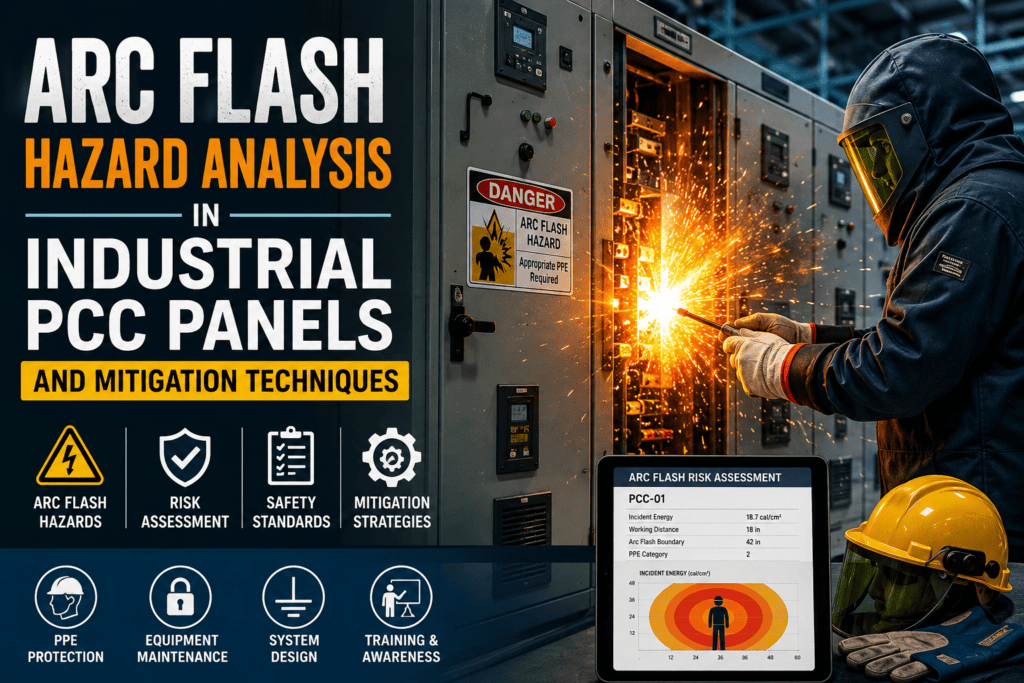
An arc flash hazard analysis evaluates the severity of potential arc flash incidents within an electrical system. In industrial PCC panels, this analysis focuses on determining the amount of incident energy that workers may be exposed to during an arc flash event.
Key parameters evaluated during arc flash analysis in power distribution panels include:
- available short circuit current
- system voltage levels
- clearing time of protective devices
- conductor spacing and panel configuration
- working distance from the electrical equipment
Using these parameters, engineers calculate the incident energy level (cal/cm²) at different locations in the electrical system.
The calculated incident energy helps determine the required arc flash protection category and personal protective equipment (PPE) needed for safe operation and maintenance.
Fault Current and Protection Speed: Critical Factors in Arc Flash Severity
Two electrical parameters strongly influence the magnitude of an arc flash hazard in PCC panels.
Available Fault Current
The higher the available fault current at the PCC panel, the more energy is released during an arc flash event. Industrial facilities with large transformers and high-capacity power systems often experience very high fault current levels.
Protective Device Clearing Time
The time required for circuit breakers or protection relays to interrupt the fault current plays a major role in arc flash severity. Longer clearing times allow the arc to persist longer, significantly increasing incident energy.
For this reason, modern arc flash protection strategies in PCC panels focus heavily on reducing the fault clearing time through advanced protection systems.
Engineering Techniques for Arc Flash Mitigation
Once an arc flash hazard analysis is completed, engineers can implement multiple strategies to reduce risk within industrial PCC panels.
High-Speed Protection Relays
Advanced protection relays can detect arc faults almost instantly and trigger circuit breaker tripping within milliseconds. Faster interruption significantly reduces arc flash energy levels.
Zone Selective Interlocking (ZSI)
ZSI technology allows upstream and downstream protective devices to communicate with each other. This coordination enables faster fault isolation within the affected zone while maintaining system selectivity.
Arc Flash Detection Systems
Some modern PCC panels include optical arc flash detection systems that use light sensors and current detection to identify arc events immediately. These systems can trip breakers extremely quickly, limiting arc energy.
Remote Switching and Monitoring
Remote operation of industrial PCC panels allows operators to perform switching operations from a safe distance, reducing personnel exposure to arc flash hazards.
These mitigation techniques significantly enhance arc flash protection in industrial power distribution systems.
Panel Design Strategies That Reduce Arc Flash Risk
Apart from protective devices, the physical design of industrial PCC panels also influences arc flash risk.
Electrical engineers implement several design practices to improve safety:
- segregated busbar compartments to limit arc propagation
- insulated busbar systems to prevent accidental contact
- arc-resistant panel enclosures
- improved cable management and conductor spacing
These design improvements help contain arc energy and reduce the likelihood of arc flash incidents within power control center panels.
Synchro Electricals: Designing Safer PCC Panels for Industrial Power Systems
Synchro Electricals manufactures industrial PCC panels designed with advanced safety considerations for modern manufacturing facilities. The company integrates reliable protection systems, robust busbar designs, and intelligent panel configurations to enhance arc flash protection in PCC panels.
Each PCC panel from Synchro Electricals is engineered to support high fault current environments while maintaining safe electrical operation. By incorporating modern protection technologies and optimized panel design, these panels help reduce electrical hazards in industrial power distribution networks.
With strong expertise in industrial electrical panels and power distribution systems, Synchro Electricals provides reliable solutions that prioritize both operational efficiency and electrical safety.
Strengthening Electrical Safety in Industrial Power Distribution
As industrial electrical systems continue to grow in capacity and complexity, the importance of arc flash hazard analysis in PCC panels becomes even more critical.
Through accurate incident energy calculations, improved protection coordination, and advanced mitigation techniques, engineers can significantly reduce arc flash risks in industrial facilities.
Implementing strong arc flash protection strategies in PCC panels not only protects personnel and equipment but also ensures the long-term reliability of industrial power distribution systems.