Battery Energy Storage Systems (BESS) have become an essential component of modern power infrastructure. With the growing integration of renewable energy sources such as solar and wind, large-scale battery systems are increasingly deployed to stabilize grid operations, manage peak loads, and provide backup energy during power disturbances.
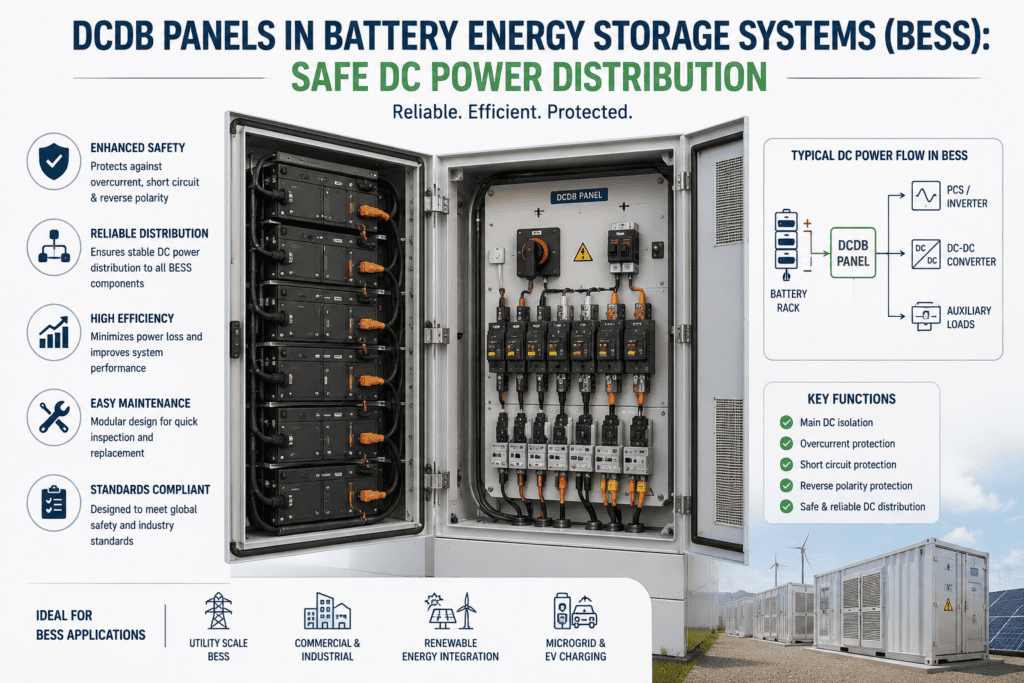
At the core of this architecture lies the DCDB panel, a specialized DC distribution board used in battery energy storage systems to manage and protect the flow of high-voltage direct current. In large energy storage installations, DCDB panels for BESS collect DC power from battery strings and safely route it to the power conversion system (PCS) that converts DC power into usable AC electricity.
Because battery energy storage systems operate with high DC voltages, large current flows, and dynamic charge–discharge cycles, the engineering of DCDB panels in BESS installations must address critical factors such as DC fault interruption, surge protection, thermal stability, and system monitoring.
Where DC Distribution Sits in the BESS Power Architecture
A battery energy storage system typically consists of multiple battery racks connected in series and parallel configurations to achieve the required voltage and capacity. These battery strings generate high-voltage DC power that must be safely aggregated before being delivered to the inverter system.
The DCDB panel in a BESS facility functions as the electrical consolidation point for these battery strings. It integrates incoming DC feeders from multiple battery racks and distributes the combined power toward the power conversion system.
Unlike traditional AC power distribution, DC power distribution in battery storage systems requires specialized engineering considerations. The absence of natural current zero-crossing in DC circuits means that fault currents behave differently, making DC fault interruption and protection coordination more complex.
As a result, DCDB panels used in battery energy storage installations must incorporate components specifically designed for high-voltage DC switching and protection.
Electrical Protection Strategy Inside BESS DCDB Panels
Because battery energy storage systems contain large amounts of stored electrical energy, any fault condition can propagate rapidly if not isolated quickly. For this reason, protection systems integrated within DCDB panels for BESS applications must respond quickly and reliably.
Protection mechanisms typically integrated in DCDB panels used in energy storage systems include:
- DC circuit breakers capable of interrupting high DC fault currents
- DC-rated fuses for string-level protection
- surge protection devices (SPDs) to protect power electronics from transient overvoltages
- DC isolators and disconnect switches for safe maintenance and emergency shutdown
These protective components ensure that faults occurring in one battery string can be isolated without affecting the entire battery energy storage power network.
Proper protection coordination within DC distribution panels for BESS is therefore essential to maintain system reliability and prevent cascading failures.
Managing High Current Flow in DC Busbar Systems
Inside DCDB panels for battery storage systems, busbars act as the main conductors carrying DC power from battery strings toward the inverter interface. Because BESS installations often operate at voltage levels between 600V and 1500V DC, the current levels inside the DC distribution board can be extremely high.
As current flows through the DC busbar system, resistive heating occurs according to electrical loss equations. Excessive heat can degrade insulation materials, affect conductor integrity, and reduce equipment lifespan.
To manage this, engineers designing DCDB panels in battery energy storage facilities must carefully evaluate:
- busbar material conductivity
- cross-sectional area of conductors
- spacing between busbars
- enclosure thermal characteristics
Proper thermal design ensures that DCDB panels handling high current loads in BESS systems maintain safe operating temperatures during both charging and discharging cycles.
Addressing DC Arc Risks in Battery Storage Systems
One of the most important safety considerations in DC power distribution for BESS installations is arc formation during switching or fault conditions.
Unlike AC circuits, DC arcs do not extinguish naturally because current does not pass through zero during the cycle. Once formed, a DC arc can persist unless interrupted by specially designed switching devices.
This makes DC-rated protection devices within DCDB panels essential for safe system operation. Engineers must ensure that all switching equipment used in BESS DC distribution boards is capable of safely interrupting DC fault currents.
Proper insulation coordination and conductor spacing inside the panel also help minimize the likelihood of arc formation during abnormal operating conditions.
Integration with Monitoring and Control Systems
Modern battery energy storage systems rely heavily on digital monitoring platforms that supervise both electrical and battery performance. The DCDB panel in BESS installations often integrates monitoring devices that provide real-time visibility into DC electrical parameters.
These monitoring systems track parameters such as:
- DC voltage levels from battery strings
- current flow through distribution feeders
- temperature conditions inside the panel
- fault conditions and protective device status
The collected data is typically transmitted to supervisory systems such as SCADA platforms or battery management systems (BMS). This integration allows plant operators to maintain full visibility of DC power distribution within the energy storage system.
Engineering Reliability for Large-Scale Energy Storage
As grid-scale battery energy storage systems continue to grow in capacity, the reliability of DC electrical infrastructure becomes increasingly important. The DCDB panel plays a crucial role in maintaining safe power flow between battery arrays and power conversion systems.
A well-designed DCDB panel for BESS applications must balance several engineering priorities: electrical protection, thermal performance, mechanical strength, and operational monitoring.
When these elements are properly integrated, the DC distribution system can support the demanding operational cycles of modern energy storage facilities while maintaining high levels of safety and reliability.
With the global expansion of renewable energy and grid stabilization technologies, DCDB panels will remain a foundational component of safe and efficient DC power distribution in battery energy storage systems.