Walk into a modern manufacturing facility today, and you’ll notice that electrical panels are no longer operating as isolated control units. Production equipment, PLCs, motor drives, energy meters, sensors, SCADA platforms, and ERP systems are constantly exchanging information. The electrical panel has evolved from a power distribution device into a communication hub.
This shift is one of the driving forces behind Smart Electrical Panels Communication. In smart factories and Industry 4.0 environments, the ability of smart control panels to communicate with multiple devices determines how efficiently a facility can monitor operations, manage energy consumption, and respond to faults.
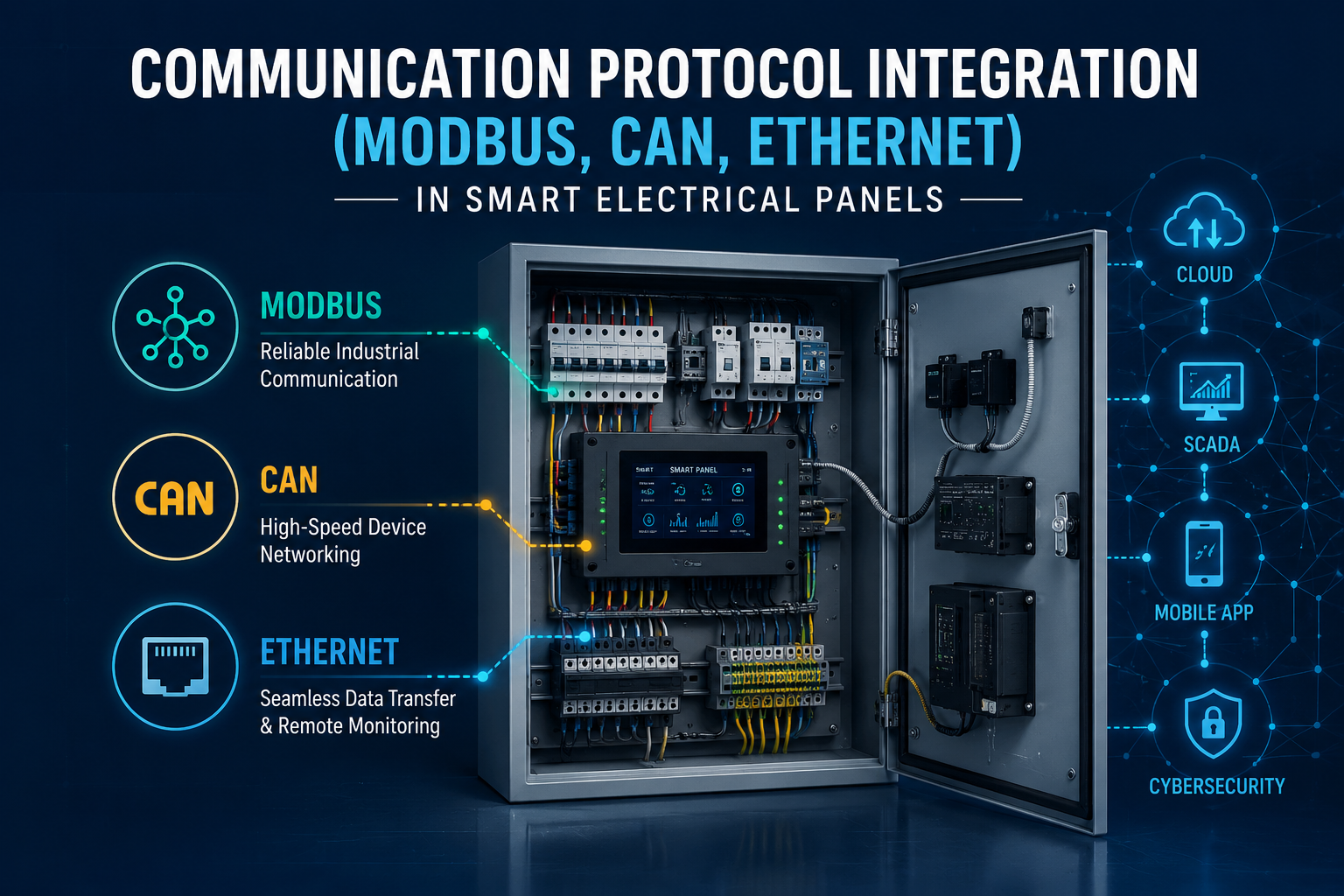
Technologies such as Modbus communication, CAN Bus integration, and Industrial Ethernet networks have become essential for enabling real-time connectivity inside modern smart electrical panels.
From Switchgear to Data Hub
Traditionally, electrical panels handled power distribution and equipment protection. Operators walked the floor, checked meters, read indicators, and drew their own conclusions about system performance.
That’s not how modern manufacturing facilities work anymore.
Production managers want real-time equipment data. Maintenance teams need predictive diagnostics. Energy managers require consumption analytics. Plant operators expect remote access to alarms and performance parameters – not a walk to the panel room.
Meeting all of that demands continuous communication between field devices and central control systems. This is why modern smart manufacturing control panels integrate communication protocols directly into the panel architecture, allowing data to move seamlessly between electrical equipment and plant-wide automation platforms.
Why Different Communication Protocols Exist
Not every industrial device speaks the same language. A motor drive may use one protocol while an energy meter uses another. Industrial automation has evolved around multiple communication technologies rather than forcing everything through a single standard – each one optimised for specific applications.
The three most commonly integrated protocols in smart electrical panels are Modbus, CAN Bus, and Industrial Ethernet. Each serves a different purpose and offers different advantages depending on the complexity of the application.
Modbus: Still the Most Widely Used Industrial Communication Protocol
Despite being one of the oldest industrial communication standards, Modbus communication in smart electrical panels remains extremely common. That says something.
Its staying power comes from simplicity and interoperability. Devices from different manufacturers exchange information using a standard communication structure without complex configuration on either end.
Within smart control panels, Modbus handles communication between energy meters, PLC systems, motor protection relays, Variable Frequency Drives (VFDs), and APFC controllers – reliably, and without fuss.
Because of that reliability and ease of implementation, Modbus continues to be the go-to choice in industrial electrical panels across manufacturing plants, utility facilities, and process industries.
CAN Bus: Built for Fast Device-Level Communication
Where Modbus handles supervisory communication, CAN (Controller Area Network) was designed for something different – fast, reliable communication directly between electronic devices.
CAN technology is widely used in industrial automation, machine control systems, material handling equipment, and mobile machinery. One of its real strengths is performing well in electrically noisy environments, which describes most manufacturing facilities accurately.
In smart electrical control panels, CAN communication gets used where rapid device-to-device interaction is the priority. The protocol moves data efficiently while keeping network traffic lean, making it a natural fit for distributed control architectures.
As manufacturing systems grow more interconnected, CAN Bus integration in smart control panels keeps expanding its footprint.
Ethernet Is Driving Industry 4.0 Connectivity
The most significant shift in industrial communication has been the widespread adoption of Ethernet-based networks. It changed what connectivity inside a panel could actually mean.
Unlike traditional serial communication systems, Industrial Ethernet delivers high-speed data transfer, greater scalability, and direct integration with enterprise-level software platforms.
Smart electrical panels with Ethernet communication connect to SCADA systems, Manufacturing Execution Systems (MES), ERP platforms, cloud monitoring applications, and Industrial IoT platforms. Real-time monitoring of production assets from anywhere in the organisation becomes straightforward rather than a project.
For manufacturers pursuing digital transformation, Ethernet has become the backbone of Industry 4.0 electrical panel communication systems, and that position isn’t changing.
The Real Value Isn’t Communication – It’s Visibility
Getting protocols into a panel is not the end goal. What that communication enables is the point.
When devices inside smart electrical panels exchange data continuously, plant personnel gain genuine visibility into electrical performance, equipment health, and operational efficiency. Maintenance teams spot developing issues before they become failures. Energy consumption trends become readable and actionable. Fault diagnostics get faster and more accurate.
That shift from reactive operation to data-driven decision-making is why manufacturers keep investing in smart electrical panel communication systems. The panels aren’t just running equipment anymore — they’re generating the information that runs the facility.
Designing Panels for Connected Manufacturing
At Synchro Electricals, communication requirements are increasingly as important as power distribution requirements in any panel brief. Modern smart control panels have to support electrical performance and seamless integration with industrial automation networks – both, not one or the other.
Our engineering approach covers protocol compatibility, communication architecture, future scalability, and integration with plant-wide monitoring systems. Whether a project calls for Modbus communication, CAN Bus connectivity, or Industrial Ethernet integration, the objective stays the same: smart electrical panels that support efficient, connected manufacturing operations.
The Future of Smart Electrical Panels
Industrial automation is changing what electrical infrastructure is expected to do. Panels are no longer viewed as switchgear assemblies – they’re becoming intelligent data collection and communication platforms.
As manufacturers adopt predictive maintenance, digital twins, Industrial IoT, and advanced analytics, communication capabilities will carry more weight in panel design with every passing year.
Modbus, CAN, and Ethernet communication protocol integration in smart electrical panels is already helping facilities improve visibility, efficiency, and operational control. For modern manufacturing environments, connected electrical panels have moved from being an advantage to being a baseline requirement.
FAQs
1. What communication protocols are commonly used in smart electrical panels?
Modbus, CAN Bus, and Industrial Ethernet are the most widely used. Each one serves a different layer of the communication architecture inside a smart panel.
2. Why is Modbus popular in industrial automation?
It’s simple, reliable, and works across a wide range of devices from different manufacturers without requiring complex setup on either end.
3. What is CAN Bus used for in electrical control panels?
Fast, reliable device-to-device communication – particularly in distributed control and automation systems where response speed matters and network traffic needs to stay lean.
4. How does Ethernet improve smart panel connectivity?
It provides high-speed communication and direct integration with SCADA, MES, ERP, and Industrial IoT platforms – connecting panel-level data to the rest of the organisation in real time.
5. What are the benefits of communication-enabled electrical panels?
Better monitoring, faster fault diagnostics, clearer energy management data, predictive maintenance capability, and operational visibility that reactive panel setups simply can’t match.