Power factor correction has become a standard requirement across industrial plants, commercial buildings, utilities, and infrastructure projects. APFC panels (Automatic Power Factor Correction Panels) are designed to improve power factor and reduce utility penalties, but their performance depends heavily on how they interact with the electrical network.
In modern facilities where VFDs, UPS systems, servo drives, solar inverters, and automation equipment are common, simply installing capacitor banks is no longer enough. Switching transients and harmonic distortion both need to be addressed for the system to hold up long-term. That’s what makes APFC harmonic mitigation an important consideration in modern power distribution systems — not a nice-to-have, but part of getting the design right.
The Instant Impact of Capacitor Bank Switching
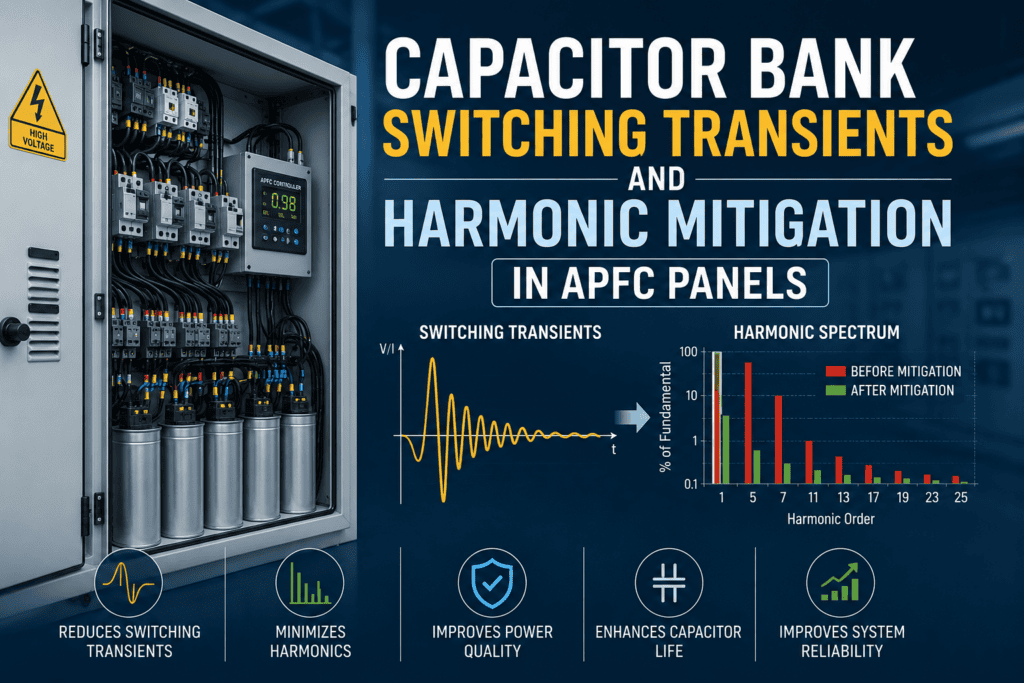
Every time a capacitor bank switches ON inside an APFC panel, a sudden charging current rushes into the capacitor. That surge creates a short-duration electrical disturbance — a switching transient.
The event itself lasts a fraction of a second. The problem is what that voltage and current spike does to sensitive equipment connected elsewhere on the network. In large industrial facilities running multiple capacitor stages, frequent switching adds up. Contactors, capacitors, and protection devices all absorb that stress over time.
This is why switching device selection and capacitor bank configuration get careful attention when engineers are designing industrial APFC panels.
Why Harmonics and APFC Panels Must Be Considered Together
Most industrial and commercial facilities today run a substantial number of non-linear loads. Variable frequency drives, rectifiers, UPS systems, CNC machines – all of them generate harmonic currents that distort the normal power waveform.
Those harmonics and capacitor banks don’t coexist quietly.
Capacitors naturally attract higher-frequency currents, which puts them directly in the path of harmonic overload. Under certain conditions the electrical system hits resonance, and when that happens, current through the capacitor bank climbs to levels it was never designed for. Overheating follows. Then capacitor failure, nuisance tripping, and shortened panel life.
This is why modern APFC panel design can’t focus only on reactive power compensation. Power quality and harmonic distortion have to be part of the same conversation.
Identifying Harmonic Risks Before They Become Problems
Before specifying an automatic power factor correction panel, engineers typically run a power quality assessment of the facility. The goal is to find out whether standard capacitor banks are appropriate or whether harmonic levels in the system demand additional mitigation.
That assessment usually covers:
- Total Harmonic Distortion (THD) levels
- Type of connected loads
- Existing power factor performance
- System short-circuit capacity
- Capacitor bank sizing requirements
Working through this upfront is what prevents the APFC panel from creating resonance conditions in the very network it was installed to improve.
How Detuned Reactors Protect Capacitor Banks
The most widely used solution for harmonic mitigation in APFC panels is the detuned reactor.
Connected in series with the capacitor bank, a detuned reactor shifts the resonance frequency away from the dominant harmonics present in the system. Instead of the capacitors amplifying harmonic currents, the circuit limits their impact before damage occurs.
The practical benefits stack up:
- Improved capacitor life
- Reduced thermal stress
- Better power quality
- Lower risk of resonance
- Enhanced reliability of APFC systems
For manufacturing plants, commercial complexes, and infrastructure facilities carrying significant non-linear loads, detuned APFC panels are typically the right call rather than the cautious one.
Designing APFC Panels for Modern Industrial Applications
Today’s industrial APFC panels have to do more than correct power factor. System stability, equipment protection, and harmonic management all sit inside the same design brief.
At Synchro Electricals, capacitor bank sizing, harmonic levels, switching frequency, and power quality requirements all feed into how we design APFC panels for industrial power distribution systems. Power factor correction should improve the network, not introduce new problems into it.
Proper switching technology combined with effective harmonic mitigation strategies is what allows APFC panels to perform reliably over years of operation in demanding industrial environments — not just at commissioning.
Conclusion
Capacitor banks remain essential for improving power factor and reducing energy losses. But the way they interact with harmonics can’t be treated as a secondary concern. Without proper engineering, switching transients and resonance conditions quietly degrade both the APFC panel and the wider electrical system around it.
Careful analysis, sound capacitor bank design, and detuned reactors for harmonic mitigation are what allow facilities to achieve genuine power factor correction without paying for it in power quality.
As industrial electrical networks keep evolving, APFC harmonic mitigation, reliable capacitor bank switching, and intelligent panel design will stay at the centre of efficient and stable power distribution — because the loads driving harmonic distortion aren’t going away.