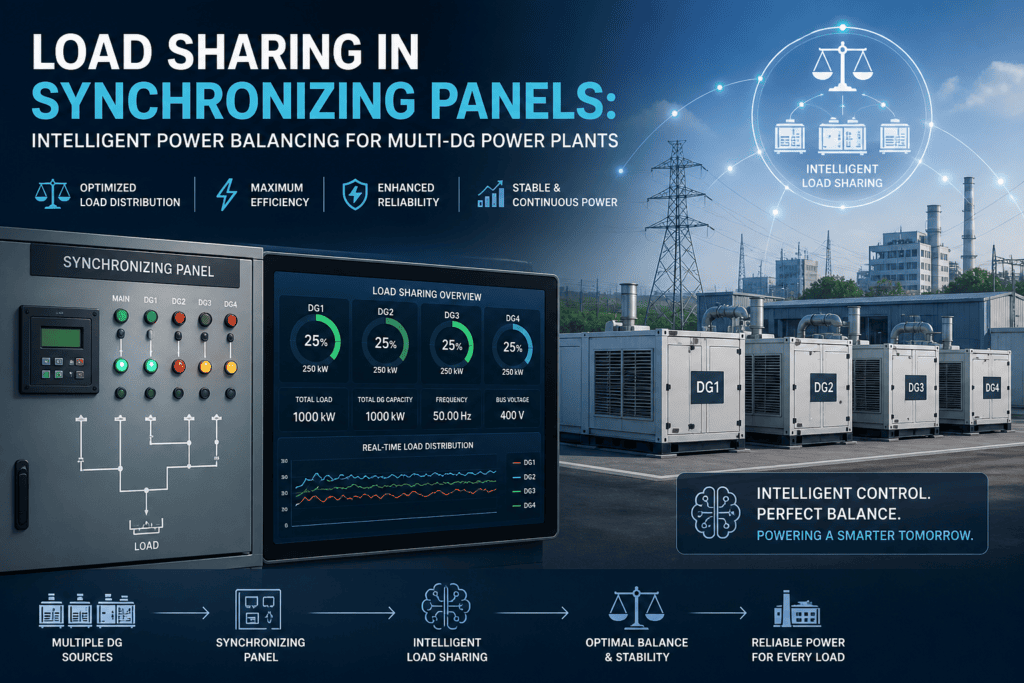
Industrial facilities that rely on multi-DG power plants face a critical operational challenge – how to distribute electrical load efficiently across multiple generators. When several diesel generators operate together without proper coordination, the result can be unstable frequency, inefficient fuel usage, and uneven mechanical stress.
This is where automatic synchronizing panels play a vital role. Modern synchronizing panels integrate intelligent load sharing algorithms that automatically balance electrical demand among generators operating on the same busbar.
In large-scale power generation systems, proper load sharing in synchronizing panels ensures that each DG set contributes proportionally to the total power demand, improving efficiency and protecting expensive generator equipment.
Understanding the Load Sharing Challenge in Multi-DG Power Plants
Running a single diesel generator is relatively simple. However, when multiple generators operate simultaneously in industrial power plants, maintaining equilibrium becomes significantly more complex.
Each generator must match system parameters such as frequency, voltage, and phase angle before connecting to the power bus. Once connected, the generators must continuously adjust their output so that the electrical load is evenly distributed.
Without an effective load sharing mechanism in synchronizing panels, several operational problems can arise:
- One DG set may become overloaded
- Other generators may run underutilized
- Fuel efficiency may drop significantly
- Generator engines may experience premature wear
Advanced synchronizing panels used in power generation plants prevent these issues by implementing intelligent load distribution logic.
How Automatic Synchronizing Panels Manage Generator Coordination
A synchronizing panel acts as the control center of a multi-generator power system. It monitors electrical parameters from each generator and ensures that generators connect to the system safely.
Once synchronization is achieved, the panel’s control system manages generator output using specialized load sharing algorithms.
The panel continuously monitors parameters such as:
- Generator real power output (kW)
- System frequency and voltage
- Generator engine speed
- Power factor
Based on these readings, the automatic synchronizing panel dynamically adjusts generator performance to maintain balanced load distribution across all running DG sets.
Key Load Sharing Strategies Used in Modern Synchronizing Panels
Modern industrial synchronizing panels rely on several control methods to maintain stable generator operation. Each method is designed to ensure reliable load sharing in multi-DG power plants.
1. Droop-Based Load Sharing
The droop method is one of the most widely implemented techniques in automatic synchronizing panels. In this system, a generator’s frequency slightly decreases as its load increases.
Because every generator follows this behavior, the load naturally distributes across all DG sets connected to the bus. This method is commonly used in industrial power plants and manufacturing facilities due to its simplicity and reliability.
2. Isochronous Control for Precision Power Distribution
In facilities that demand extremely stable power – such as data centers or healthcare infrastructure – more precise control is required.
Isochronous control allows one generator to maintain system frequency while other generators share load proportionally. This approach ensures tight load regulation while maintaining stable electrical parameters across the entire system.
3. Digital Load Sharing Controllers
Modern synchronizing panels for power generation plants increasingly use microprocessor-based controllers that perform real-time load management.
These controllers communicate between generators and continuously adjust fuel injection and engine speed, ensuring optimal load balancing. Digital control systems improve both efficiency and system stability in large multi-generator installations.
Operational Advantages of Intelligent Load Sharing
Well-designed load sharing systems in synchronizing panels significantly improve generator plant performance. For industrial power facilities, these benefits directly translate into lower operating costs and improved system reliability.
Key operational advantages include:
Balanced Generator Utilization
All DG sets share electrical demand evenly, preventing overload conditions.
Improved Fuel Efficiency
Generators running at optimal load levels consume less fuel per unit of power generated.
Enhanced System Stability
Stable voltage and frequency are maintained even during sudden load changes.
Reduced Equipment Wear
Balanced load distribution minimizes mechanical stress on generator engines and alternators.
These advantages make automatic synchronizing panels with advanced load sharing algorithms essential for modern power generation systems.
Engineering Considerations for Synchronizing Panel Design
Designing synchronizing panels for multi-DG power plants requires advanced electrical engineering expertise. Panel design must ensure accurate measurement, reliable control, and strong protection mechanisms.
Critical components of a high-performance industrial synchronizing panel include:
- Precision voltage and frequency sensors
- Intelligent load sharing controllers
- Programmable logic controllers (PLC)
- Protection relays for reverse power and overload conditions
- High-quality busbar systems
Together, these components enable reliable load sharing in synchronizing panels, ensuring smooth generator coordination in demanding industrial environments.
Synchro Electricals: Advanced Synchronizing Panel Solutions
Synchro Electricals is a trusted manufacturer of industrial synchronizing panels and generator control systems designed for reliable multi-DG power plant operations.
The company’s automatic synchronizing panels incorporate advanced control technologies and intelligent load sharing algorithms, ensuring stable generator coordination and efficient power distribution.
With deep expertise in industrial electrical panel manufacturing, Synchro Electricals delivers solutions that support power plants, infrastructure projects, manufacturing facilities, and critical power installations.
By combining engineering precision with robust panel design, Synchro Electricals helps industries maintain reliable and efficient generator synchronization and load management systems.
Final Thoughts
Operating multiple generators efficiently requires more than just connecting them to the same power bus. Proper coordination through synchronizing panels with advanced load sharing algorithms is essential for maintaining system stability and optimizing generator performance.
From droop-based control to digital load sharing systems, modern automatic synchronizing panels provide the intelligence needed to manage complex multi-DG power plants.
For industrial facilities that rely on dependable power generation, investing in high-quality synchronizing panels engineered for efficient load sharing ensures long-term operational reliability and energy efficiency.